
Sound the Alarm
To the reasonable Poles who keep telling me Nawrocki doesn’t represent them: your country is producing what a fascist state looks like in formation. Your silence is what allows it to spread.

Alina Teslenko is a Ukrainian mother living in Poland. She wrote this on Facebook a few days ago:
“Xenophobia in Poland has also affected our family. I always read such posts and even thought to myself that something like this would happen to my children. Then the woman came up and asked: ‘Who is laughing here?’ The children did not answer. Suddenly, without any warning, she punched my daughter in the neck. The girl fell to the ground. In the same second, my daughter received a punch in the face. A boy from Ukraine who wanted to stand up for the children also got punched and had his nose broken. My second daughter dared to ask: ‘Why did you do this?’ The Polish woman answered: ‘Because you are from Ukraine.’”
Let that sit for a moment.
“Because you are from Ukraine.”
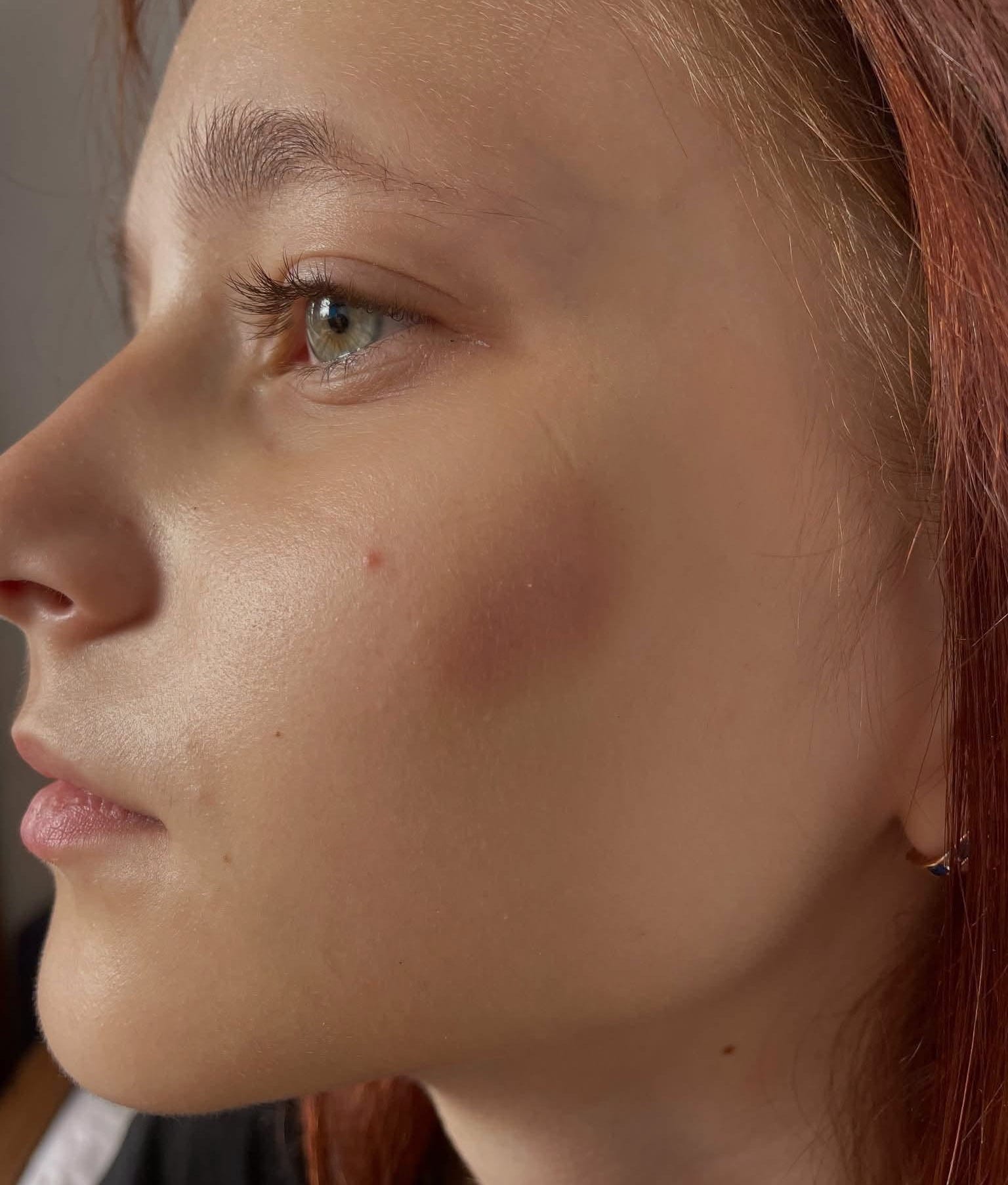
(Photo of Alina Teslenko’s daughter who was hit by a Polish woman)
An adult Polish woman walked up to a group of children on a Polish street, punched a little girl in the neck, punched another girl in the face, and broke the nose of a boy who tried to defend them. She named her reason.
I want to speak directly to the Poles who keep telling me that Nawrocki does not represent them. That the anti-Ukrainian rhetoric coming out of Warsaw is fringe. That most Poles still support Ukraine. That I should stop writing about this because I am playing into russian hands.
You are wrong. And I am going to explain why, using the facts your own police, your own polls, and your own citizens are producing every day.
What Polish police are reporting
According to data released last week by Poland’s National Police Headquarters, there were 180 reported hate crimes against Ukrainians in Poland during the first half of 2026 alone. That is a 30 percent increase over the same period in 2025, and a 35 percent increase over the same period in 2024. If the current pace continues, the full-year total will exceed 360 reported incidents – higher than 2024 and 2025 combined.
These are reported incidents. Most Ukrainians who experience harassment or assault in Poland do not go to the police. They do not trust that the police will help. Julia Chypizhuk, a Ukrainian mother who was attacked at a bus stop after Sunday Mass by a Polish woman who told her she wished russia had killed her, wrote under one of my recent posts: “I called Police – they never came to protect women with a young child. Of course they didn’t bother to look for this women. We don’t live in Poland anymore. But me and my child still remember.”
The 180 reported incidents in six months is the visible surface. The actual scale is many times larger.
The pattern is now impossible to deny
In the past two weeks alone, these are the documented cases that reached mainstream Polish and international media:
Bielsko-Biała, bus: An adult Polish man verbally attacks teenage Ukrainian girls on a municipal bus for speaking Ukrainian. Video goes viral. Polish volunteer Mateusz Rybak – a man who has spent years personally helping Ukraine – writes: “I despise such Poles. Touching a child just because she comes from Ukraine is total rock bottom.” The perpetrator is eventually detained.
Płock, bus: A 15-year-old Ukrainian boy and his girlfriend are attacked by an adult Polish man on a city bus for speaking Ukrainian. The man tells them “in Poland you need to speak Polish,” hits the boy in the face, and pushes both teenagers off the bus. The boy’s mother says her son can no longer feel safe. “I’m afraid to speak my own language, I really am,” she says.
Wrocław, Słodowa Island (July 4): A 19-year-old Ukrainian is beaten by a group of Polish men for speaking Ukrainian on the phone. Broken nose. Spinal injury. Multiple bruises.
Łódź: A Polish man attacks a stranger he hears speaking on the phone, assuming he is Ukrainian and shouting at him that he does not belong in Poland. The victim, who is punched repeatedly in the head, turns out to be Polish. The confusion does not change what the attacker intended.
Warsaw: Two Polish far-right activists are formally charged over an incident targeting a Ukrainian businesswoman who runs services for immigrants.
Alina Teslenko’s daughter and the Ukrainian boy whose nose was broken: the incident above. Filed with police. Injuries documented. Perpetrator’s motive stated in her own words: “because you are from Ukraine.”
A twelve-year-old Ukrainian girl on a bus: shouted at by an adult Polish man for speaking Ukrainian, told to go home.
A Ukrainian woman in her own apartment: a Polish neighbor shot through her window because she was speaking Ukrainian. A week earlier, the same man had been shouting insults at Ukraine and Ukrainians. The police were called twice. Officers took nearly two hours to arrive. The residents waited in fear, unsure whether another shot would be fired.
Each incident, taken alone, is an outrage. Taken together, they are a pattern. Taken with the 180 police reports and the actual larger number underneath them, they are a national phenomenon. And this is only the past few weeks.
What Ukrainians in Poland are telling me
Under every post I write about this, Ukrainians living in Poland are writing to me to say that this is happening to them all the time. Not once. Not occasionally. Continuously.
Yaroslav Zadorovskyy: “My friend’s two children were bullied at school in Wrocław only because they’re Ukrainians. These incidents are numerous and only a handful get reported to the police.”
Valerie Budac: “This is not a singular case. My niece is just a child and she has been bullied in schools for the past few years now – she even changed schools. She assimilated fully, she is fluent in Polish, they are not on government help and work day and night to provide and pay taxes in Poland. My niece is constantly being told ‘to return where she comes from’ but there is nowhere to return to! The house got bombed by ruzzia. They lived in the epicenter of things. Who teaches Polish kids to bully Ukrainian kids? Their parents. They see and listen to things at home.”
Kristofers Džons Akenfelds (Latvian, comparing his own country to Poland): “I have a Ukrainian friend in Warsaw and she told me they’re hated in Poland. It was sad because I know a lot of Ukrainians in Latvia and they don’t get treated badly at all.”
Notice what these testimonies establish. This is not fresh. This is not a spike caused by one bad month. Ukrainians have been experiencing this for years. Children have been bullied in Polish schools for so long that families are changing schools to escape it. The families being targeted are working, paying Polish taxes, fluent in Polish, and integrated – and it does not matter. What matters is that they are Ukrainian. And their children, in Polish schoolyards, are learning something about who Poles have become while russia bombs their grandparents’ houses.
The polling and academic research refutes the comfortable lie
I keep hearing from my Polish friends that “Nawrocki doesn’t represent all of Poland.” That “Poles support Ukraine.” That the incidents are the work of a small fringe of extremists.
According to a recent poll, 60 percent of Poles do not support Ukraine joining the European Union. Only 35 percent do.
This is not a fringe. This is a majority. Sixty percent of Poles are now aligned with the position President Nawrocki has been articulating – that Ukraine’s accession should be blocked or conditioned. The Nawrocki position is not an aberration. It is the majority Polish position, endorsed by 60 percent of the country and enacted by the president they elected. When you tell me Nawrocki does not represent Poland, you are telling me something that Polish polls now directly contradict.
The polling is not the only Polish evidence. Two recent Polish research findings deserve attention.
At the end of June 2026, the Polish NGO Krytyka Polityczna published a report titled “We Are Not at Home. Ukrainian Migrants and Refugees on Relations with Poles,” prepared by Dr. Olena Babakova and Professor Przemysław Sadura of the University of Warsaw. It is based on in-depth interviews with Ukrainian migrants and refugees living in Poland. Nearly all respondents reported observing a deterioration in relations with Poles. Almost all reported a rise in anti-Ukrainian sentiment – including Ukrainians who have lived in Poland for more than a decade or who now hold Polish citizenship. Many described becoming more cautious about speaking Ukrainian in public or displaying Ukrainian symbols.
This is a Polish research institution documenting, from the mouths of Ukrainians on Polish soil, exactly what I have been describing. It is not my framing. It is the finding.
The second study is more striking. Res Futura, a Polish media analytics firm, examined nearly 520,000 Polish social media posts published between May 1 and May 31, 2026. Its conclusion: anti-Ukrainian content increased exponentially during that month. Pro-migrant or supportive comments had become “extremely rare” – around one in every thousand posts.
One in every thousand!
Reasonable Poles who tell me most of their countrymen still support Ukraine are describing a reality that Polish research does not support. In Polish social media, the pro-Ukrainian voice has effectively disappeared. What remains is a monoculture of hostility, and the small handful of Poles still willing to speak up are being drowned out by a thousand-to-one ratio.
The paramilitary formation
Last week, a new group began appearing in Polish cities. It is called Narodowa Straż Kamracka – the Kamracka People’s Guard. Its members wear dark navy uniforms deliberately designed to resemble those of the Polish police. From a distance, ordinary citizens could easily mistake them for law enforcement. Across the back of each uniform is written POLSKA. Underneath: Narodowa Straż Kamracka.
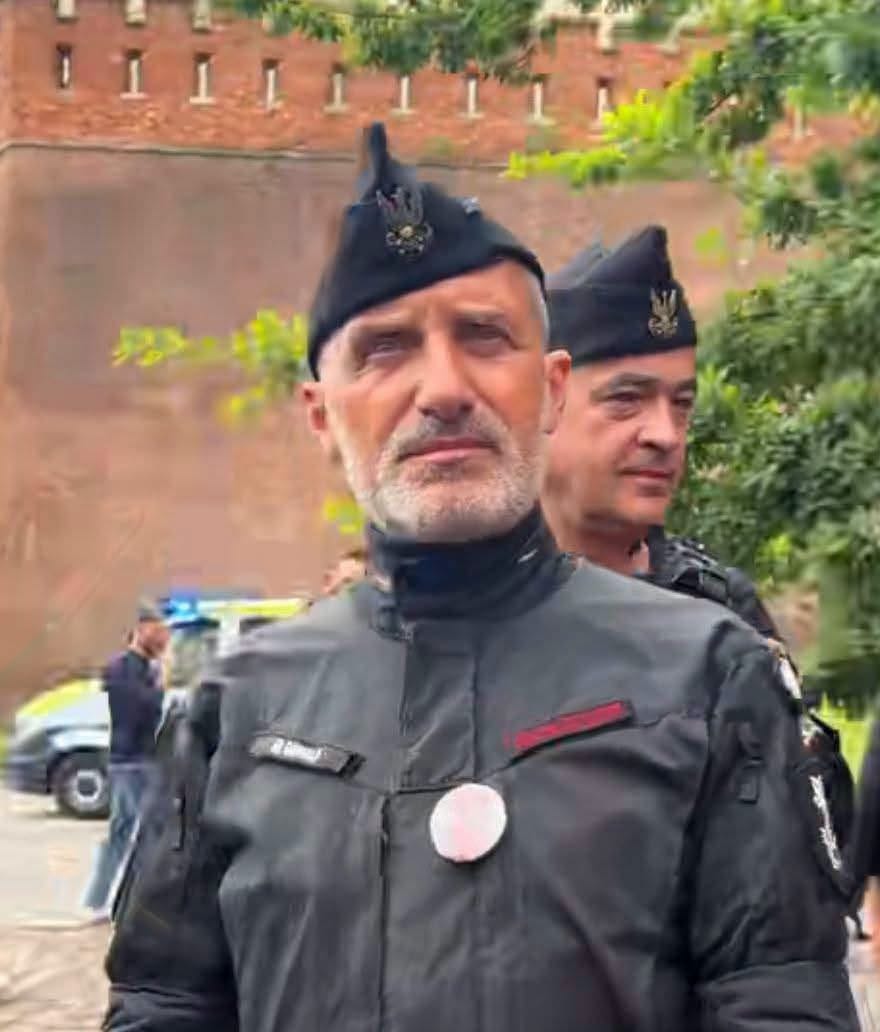
(Photo of Kamracka People’s Guard)
The group is tied to the Rodacy Kamraci movement led by Wojciech Olszański (”Jaszczur”) and Marcin Osadowski – a movement known for anti-Ukrainian rhetoric, antisemitism, and the promotion of pro-Kremlin narratives. Their members march through Polish streets. They recruit. They use nationalist slogans designed to intimidate.
Poland now has uniformed anti-Ukrainian paramilitary formations marching in its cities. When Europeans of a certain generation see uniformed political militias mimicking law enforcement while spreading anti-Jewish, anti-Ukrainian, and pro-Moscow narratives, they know what they are looking at. There is a specific twentieth-century historical name for this. Every Pole knows what that name is.
The state escalation
Meanwhile, at the top of the Polish state, President Karol Nawrocki has called for a legislative ban on the red-and-black UPA flag in Poland, claiming that these colors “embody the entire ideology of the Ukrainian nationalist.”
That flag is the flag under which my grandfather and grandmother (who was Polish) fought Nazis and Soviets, side by side, in the same forest. It is the flag under which they hid a Jewish family in their home. It is the flag of a Ukrainian national resistance that Poland’s own better historians – the honest ones – acknowledge was primarily a resistance movement against two totalitarian empires. Nawrocki wants it criminalized on Polish soil.
Nawrocki, who spent his career as director of Poland’s Institute of National Remembrance before entering politics, is himself the leading Polish nationalist of his generation. He looks more like Putin every day. And if Poland actually enacts this legislation criminalizing Ukrainian national symbols, then Poland will have moved into a legal category with russia – the only other European state that criminalizes the display of Ukrainian symbols on its own territory.
The deflections that must stop
Every time I document any of this, I receive the same coordinated set of responses. Let me name them and put them down.
“But Volhynia.” I have written three long pieces on Volhynia. I have acknowledged the atrocity. I have named Ukrainian responsibility. Ukraine carries the larger share of blame for what happened in those villages. Whatever a Ukrainian nationalist commander did in 1943 does not license a Polish adult to punch a Ukrainian child in the face in 2026.
“But UPA.” The UPA fought Nazis and Soviets and included Poles and Jews among its ranks, including in my own family. A Polish state that honors the Świętokrzyska Brigade – a unit that literally fought alongside the Third Reich until May 1945 – has no standing to lecture Ukraine about the moral purity of its historical resistance movements.
“Ukrainians take Polish resources and jobs.” Ukrainian refugees in Poland pay Polish taxes. Their labor sustains sectors of the Polish economy. Multiple studies show that Ukrainian refugees have been a net positive contribution to Polish GDP. The “they take our resources” claim is the oldest xenophobic lie in Europe, deployed by every majority against every minority since the medieval period.
“Military-age Ukrainian men are hiding in Poland.” Hundreds of thousands of Ukrainian men are serving on the front line. Many are dead. Others have been wounded. Others are in captivity. The Ukrainian men in Poland are overwhelmingly there legally, are working, and in many cases are veterans, wounded, or medically exempt. The “they should be at the front” line has become an excuse for Polish adults to justify attacking Ukrainian teenagers on buses. It is despicable.
“These are isolated incidents by extremists.” 180 police reports in six months. 30 percent year-over-year increase. 60 percent of Poles opposing Ukrainian EU accession. Uniformed anti-Ukrainian paramilitary formations marching in your cities. A president calling for the criminalization of Ukrainian national symbols. Polish research finding pro-Ukrainian voices at one in every thousand social media posts. A Polish neighbor firing a gun through the window of a Ukrainian woman for speaking her own language in her own apartment. This is not isolated. This is systemic, and Poles who continue to describe it as isolated are either not paying attention or are lying to themselves.
“Nawrocki doesn’t represent all of Poland.” The polling says he represents 60 percent of it. That is the majority. If it does not represent you, sound the alarm. Silence is what tells the world you have made your peace with it.
To the reasonable Poles
I know you exist. I have Polish friends, Polish colleagues, Polish neighbors. I know the Poles who welcomed Ukrainian refugees into their homes in 2022. I know the Poles who drove supplies across the border under fire. I know the Poles like Mateusz Rybak who publicly condemn every Bielsko-Biała bus incident. I know the Poles who protested when the LAS RĄK gallery was vandalized and raised more than 150,000 złoty to restore it. That Poland is real, and I love it.
But that Poland is losing its country. And it is losing it, in part, because it is still speaking about the current escalation in the language of individual outrage – “this specific incident was horrifying” – rather than in the language of national alarm.
Sixty percent of Poles now oppose Ukrainian EU accession. Polish researchers examining 520,000 Polish social media posts found supportive voices at a rate of one per thousand. Anti-Ukrainian paramilitary formations wearing police-imitating uniforms are marching in Polish cities. Your president is calling for the criminalization of Ukrainian national symbols. Your police report a 30 percent year-over-year increase in reported hate crimes against Ukrainians. Ukrainian children in your schools are being bullied so systematically that families are leaving your country to escape it. A Polish neighbor fired a gun through the window of a Ukrainian woman in her own apartment for speaking Ukrainian. Adult Polish citizens are hitting Ukrainian children in the face and telling them the reason is that they are Ukrainian.
Your country is producing exactly what a fascist state looks like in formation. Not in metaphor. In substance. In documented pattern. In the specific institutional forms – state-level criminalization of an ethnic minority’s symbols, uniformed paramilitary intimidation, mass social permission for street violence against a specific national group – that European history knows very well.
Poland of all countries knows where this leads. Poland of all countries has spent eighty years telling the world what happens when this kind of politics is left unopposed in a European democracy.
The reasonable Poles do not need to defend themselves against me. They need to defend themselves against what their country is becoming. Every time a Polish public voice tells me to be quiet instead of turning to their own citizens and demanding they stop, that Polish voice is helping this spread.
Sound the alarm. Louder than me. Louder than Mateusz Rybak. Louder than Alina Teslenko’s daughter crying in a Polish street with a punch to the face because she is from Ukraine.
That is what patriotism looks like. That is what saving your country looks like.
And I will keep writing until you do.
Slava Ukraini. And a real Poland – decent, honest, unafraid – to those Poles who still believe in it.
This is by far one of the most brutally honest assessments of the bigotry and violence perpetrated by Poles against the Ukrainian people that I’ve seen. It would be difficult to believe, but we are seeing parallels in our own country every day with unwarranted hatred displayed toward our immigrant community. Donald Tusk appears to be a supportive voice of reason, but for how long? I hope that Ursula von der Leyen and Mark Rutte can use their positions to leverage a more conciliatory tone from Nawrocki. But, changing the mentality of 60% of the population is daunting. It is probably wishful thinking, but perhaps the appeal of returning to Ukraine at some point to help in the rebuilding of their country will prove so strong that remaining in Poland is no longer an issue.
The time has come to shift from alarm to actionable legal accountability.
Thank you for documenting these terrifying incidents, Roman. Silence and passive concern are no longer options—when xenophobic violence is fueled by political rhetoric and met with systemic police inaction, international human rights frameworks must be leveraged immediately.
The Council of Europe (CoE) provides concrete remedies and mechanisms that victims, civil society, and international partners can activate right now:
1. Legal Action via the European Court of Human Rights (ECtHR)
• Individual Applications (Article 34 ECHR): Victims who encounter unhelpful police, dismissed complaints, or inadequate investigations can file against Poland in Strasbourg. Under established case law, states have a strict positive obligation to investigate hate motives and protect physical integrity under Article 3 (prohibition of degrading treatment), Article 8 (right to personal integrity), and Article 14 (prohibition of discrimination).
• Inter-State Complaints (Article 33 ECHR): Partner nations (such as Ukraine or fellow CoE members) can bring an Inter-State case against Poland before the ECtHR to address systemic failures and administrative inaction in protecting targeted minorities.
2. High-Level CoE Oversight & Escalation
• ECRI Dossiers: Filing formal complaints and empirical evidence directly with the European Commission against Racism and Intolerance (ECRI) and the CoE Commissioner for Human Rights. ECRI can trigger rapid country visits, publish urgent warnings, and demand official accountability from the Ministry of Interior.
• PACE Urgent Debates: Delegations within the Parliamentary Assembly of the Council of Europe (PACE) can request urgent debates and resolutions concerning the spike in hate crimes and political incitement.
3. Diplomatic Sanctions & Statutory Proceedings
• Article 8 of the CoE Statute: Should a member state persistently permit widespread human rights breaches or tolerate impunity for hate crimes, the Committee of Ministers holds the authority to launch formal proceedings, suspend representation rights, or issue severe diplomatic sanctions for breaching core CoE obligations.
Documentation is step one; enforcement is step two. The legal tools are already in place—it is time to start using them.