
This Is Not Putin’s War
Russians themselves say so. Their history says so. Their society says so. The West’s fixation on one man is a systematic misdiagnosis of what is actually happening.

Somewhere in russia, a young man stands with a sign: “Enemy, remember! We are all Putin now.”
He is not a dissenting citizen. He is a member of “Young Guard” – the official youth wing of Vladimir Putin’s ruling United Russia party. His admission is the most honest sentence any russian has produced about this war.
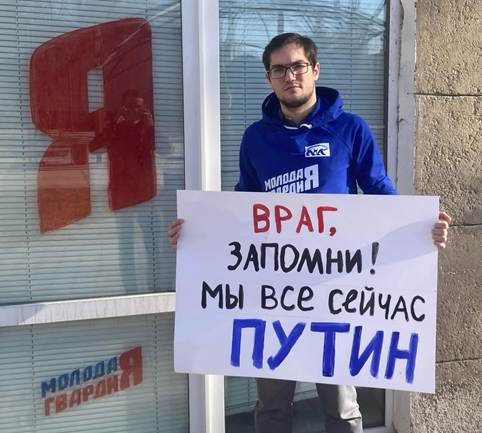
The state’s own political youth is telling the world exactly what four years of Western analysis has refused to hear: this war is not the personal project of one man. It is the collective identity of a society that has chosen to become what its leader is. When Putin acts, russians act. When russians act, Putin acts. There is no meaningful distinction, and the state’s own propaganda apparatus confirms as much.
For four years, Western analysts, politicians, and commentators have described the russian invasion of Ukraine as “Putin’s war.” The framing is comfortable because it locates the problem in a single leader and implies a single solution. Remove Putin, and the war ends. Change the leadership in the Kremlin, and russia returns to being a normal member of the international community. Wait him out.
This framing is wrong. It has been wrong for four years. The evidence that it is wrong comes from three sources that agree with each other: russians who have lived inside the system, Ukrainians who have watched it destroy their country, and historians who have watched it destroy every neighbor russia has had for five hundred years.
Let me lay out what they are saying.
What russians are doing
Start with the observable facts.
It is not Putin who is killing Ukrainians. It is russian soldiers – conscripts, contractors, Wagner mercenaries, National Guard, regular army. It is not Putin who is raping Ukrainian women and children as young as four years old, in documented cases now numbering in the hundreds. It is not Putin who is castrating Ukrainian men in filtration camps. It is not Putin who is shelling Ukrainian residential buildings, cathedrals, hospitals, and maternity wards. Russian soldiers are doing these things. Russian officers are ordering them. Russian civilians are cheering the results on Telegram.
Every credible independent survey conducted inside russia – even by researchers who use methods explicitly designed to circumvent authoritarian pressure – finds majority russian support for the war. The polling has real methodological problems, as Vladimir Milov and other russian opposition figures have pointed out. The polls are almost certainly inflated by the fear of speaking honestly to a stranger in a country where honesty is punished. But even the harshest critical readings of russian polling data do not produce a majority against the war. They produce a majority in favor of it.
If polls do not convince you, look at the russian Telegram channels. I have been following a number of them for years. Millions of russians comment freely and anonymously in these forums. They cannot be intimidated by the state because they are anonymous. They cannot be silenced because their identities are hidden. They can say exactly what they think.
What they say, every single day, is that Ukrainian cities should be burned to the ground. That Ukrainian women should be raped. That Ukrainian children should be drowned. That Ukraine as a nation should be erased. They say this after each russian missile strike on Kyiv apartment buildings – not in horror but in celebration. They say this after each documented atrocity – not in shame but in encouragement. They say this in the millions.
Now consider the russians who are not in russia. There are, by conservative estimate, more than a million russian citizens currently living in the United States and Western Europe. They can express whatever political opinion they want. They face no consequences from the russian state for opposing the war.
How many anti-war russian protests have you seen in Manhattan? In Paris? In London? In Berlin?
The overwhelming majority of russians abroad are silent. A significant number are actively pro-war. They march with russian flags. They defend the invasion in television interviews. They organize events celebrating russian victories. In the West, where they have no reason to fear the state, they align themselves with what the state is doing to Ukraine.
This is not Putin’s war. This is a war being fought, endorsed, and celebrated by russians – inside russia, outside russia, in uniform and out of it, on the front line and on Telegram, everywhere they are.
What russians can no longer see
Consider what happens when a population lives inside a systematically false reality for a very long time.
At first, propaganda distorts a population’s worldview. Then, at a certain threshold, the population begins to distort its own worldview – because self-distortion feels safer than the effort of holding onto the truth. It becomes safer not to speak, safer not to think, safer not to know. If you try hard enough not to know something, eventually you will not.
The results are visible in what russians now believe about the war.
Ordinary russians do not understand why Ukraine “attacked” russia. They are sure, however, that Ukraine is being “pushed by Europeans.” The fuel crisis in russia is not the result of Ukrainian drone strikes on russian refineries – it is an artificial crisis manufactured by oil oligarchs against ordinary russians. The attacks on russian online marketplaces and logistics warehouses are not caused by the war – they are orchestrated attacks backed by international e-commerce companies trying to seize the russian market. Ukraine, in some russian discourse, has been shelling itself in order to publish dramatic photographs.
None of this makes sense. That is the point. Reality has been so systematically inverted inside russia that the ordinary citizen has lost the ability to trace cause and effect. Everything is a conspiracy against russia. Everything painful is someone else’s fault. Everything visible is a manufactured lie.
And this is where russian society and Putin become the same thing.
Putin says there is no war. Russians repeat that there is no war. Putin says the West is the aggressor. Russians repeat that the West is the aggressor. Putin says Ukraine is a fiction. Russians repeat that Ukraine is a fiction. Not because they have been forced to. Because they have chosen to. Alignment with the state’s version of reality has become easier than the alternative, and easier than the truth. Russians have not been captured by Putin’s worldview. They have converged with it.
This is not a society that will remove Putin. This is a society that has removed reality itself – and, in the process, made itself indistinguishable from him.
What russia has always been
Russia’s current behavior is not new. It is characteristic. It has been characteristic for five hundred years.
In 1636, a German scholar named Adam Olearius traveled to Moscow. He described the russian population as “prone to violence and lacking any consistent moral compass.” He observed a society where lying was the norm, deception was celebrated as a virtue, and cruelty went unpunished by any recognized moral framework.
In 1839, the French Marquis de Custine traveled to russia and wrote what remains one of the most damning accounts of russian civilization ever produced. He described russia as a country where imperial expansion was the fundamental organizing principle, where citizens had learned to lie so instinctively that they could no longer distinguish truth from deception, and where the state used every means available to convince its neighbors and its citizens that russia was permanently under threat. His prediction: russia would spend the next two centuries invading the peoples on its borders in the name of self-defense.
He was correct.
In 2014, Zbigniew Brzezinski – hardly a marginal voice in American strategic thought – said that russia’s imperial reflex is not a feature of any particular regime but of russian identity itself. He named the pattern: russia periodically produces a leader who articulates the imperial impulse, executes it against a neighbor, and is celebrated by russian society for doing so.
Between 1550 and 2025, russia has invaded, occupied, or attempted to annex the sovereign territory of neighboring states more than fifty times. It has fought wars against Poland, Sweden, Finland, Ukraine, Belarus, Georgia, Chechnya, Estonia, Latvia, Lithuania, Moldova, Kazakhstan, Uzbekistan, Turkey, and every other country that shares a border with it. It has invaded countries hundreds of miles from its border – Afghanistan, Czechoslovakia, Hungary – whenever it perceived strategic advantage in doing so. The pattern is not accidental. It is not the work of a single dynasty or a single ideology. It is the observable historical fact of russian civilization.
Putin is one point in a long line. Ivan the Terrible, Peter the Great, Catherine the Great, Nicholas I, Stalin, Brezhnev, Putin – the specific personalities change. The imperial pattern does not. Each of them was celebrated by russian society for the same reason: because he did what russian society expects a strong russian leader to do, which is to expand russian territory at the expense of the peoples on russia’s borders.
When russians say “we are all Putin,” they are not confessing. They are telling us who they are. They have been telling us who they are for five centuries. The West has spent most of that time refusing to listen.
What the West has misdiagnosed
So what is at stake in calling this Putin’s war instead of what it is?
Everything.
If this is Putin’s war, then removing Putin ends the war. If this is russia’s war, then removing Putin changes nothing. If this is Putin’s war, then russian society is a passive audience waiting to be liberated from a captor. If this is russia’s war, then russian society is an active participant that will fight to preserve the imperial project after Putin is gone. If this is Putin’s war, then a peace deal negotiated with the Kremlin ends the threat. If this is russia’s war, then any peace deal is a pause between wars, and the West’s strategic planning must account for that.
The Western fixation on Putin as the sole cause of this war has produced four years of specific policy errors. It has produced the assumption that russia could be normalized after Putin – an assumption Kasparov, Milov and every serious russian opposition figure fully rejects. It has produced the assumption that russian society would eventually turn against the war – a turn that has visibly not happened and cannot happen because reality itself has been sealed off from russian citizens. It has produced the assumption that russian aggression is a temporary aberration in an otherwise normal European country – an assumption that five hundred years of russian history flatly contradicts.
Every one of these errors has cost Ukrainian lives.
The strategic implication is unambiguous. Russia is not a country temporarily led by a bad leader. Russia is a civilization organized around imperial expansion, whose current war against Ukraine is characteristic of who russia has been for five centuries. Removing Putin will produce a different russian leader who will continue what Putin started, because the russian society below the leader demands it. The West’s task is not to wait for a better Kremlin. The West’s task is to weaken the russian imperial project itself – its military, its economy, its ability to project force onto its neighbors – to the point where the pattern is finally, and structurally, broken.
That is a longer task than replacing Putin. But it is the only task that ends this pattern.
The russians themselves are telling us who they are.
“Enemy, know this: We are all Putin.”
Believe them.
Slava Ukraini.
I rolled my eyes at the idea that NATO aggression caused the Russian invasion, because NATO is a purely defensive organization and has enough trouble getting its members to stand up for defense. But your thesis is sound. As Russia approaches economic, military and social bankruptcy, maybe it’s time to enforce a breakup and demilitarization of Russia into its ethnic components. Due to oil, Russia could be a wealthy society and raise the standard of living for all its people, but it has chosen instead to kill many and impoverish the rest. Except for a few oligarchs. Who are now taking a hit as well.
It would be nice to believe that removing Putin would fix the problem of Russia’s structural appetite for imperialism. Even if it’s not, the cure is the same. Patriotism is easy when you have a good job, money in the bank, a full tank of gas and a little package from Wild Berries on the way. Putin’s original bargain with the Russian people, back when he was genuinely popular, was the promise of prosperity in exchange for political passivity. Time to renegotiate the contract. The great majority of people across all political systems are driven by self interest rather than ideology. Prigozhin’s march on Moscow wasn’t challenged by the general population, and hardly challenged by the garrisons they marched past. Raise the cost of patriotism for Russians. Ratchet it up into the pain zone. See what survives the fire. Then you’ll know what percentage of the population really considers themselves to be Putin’s wingmen.